Rice and Beans and the Beautiful Truth About Cheap Complete Nutrition

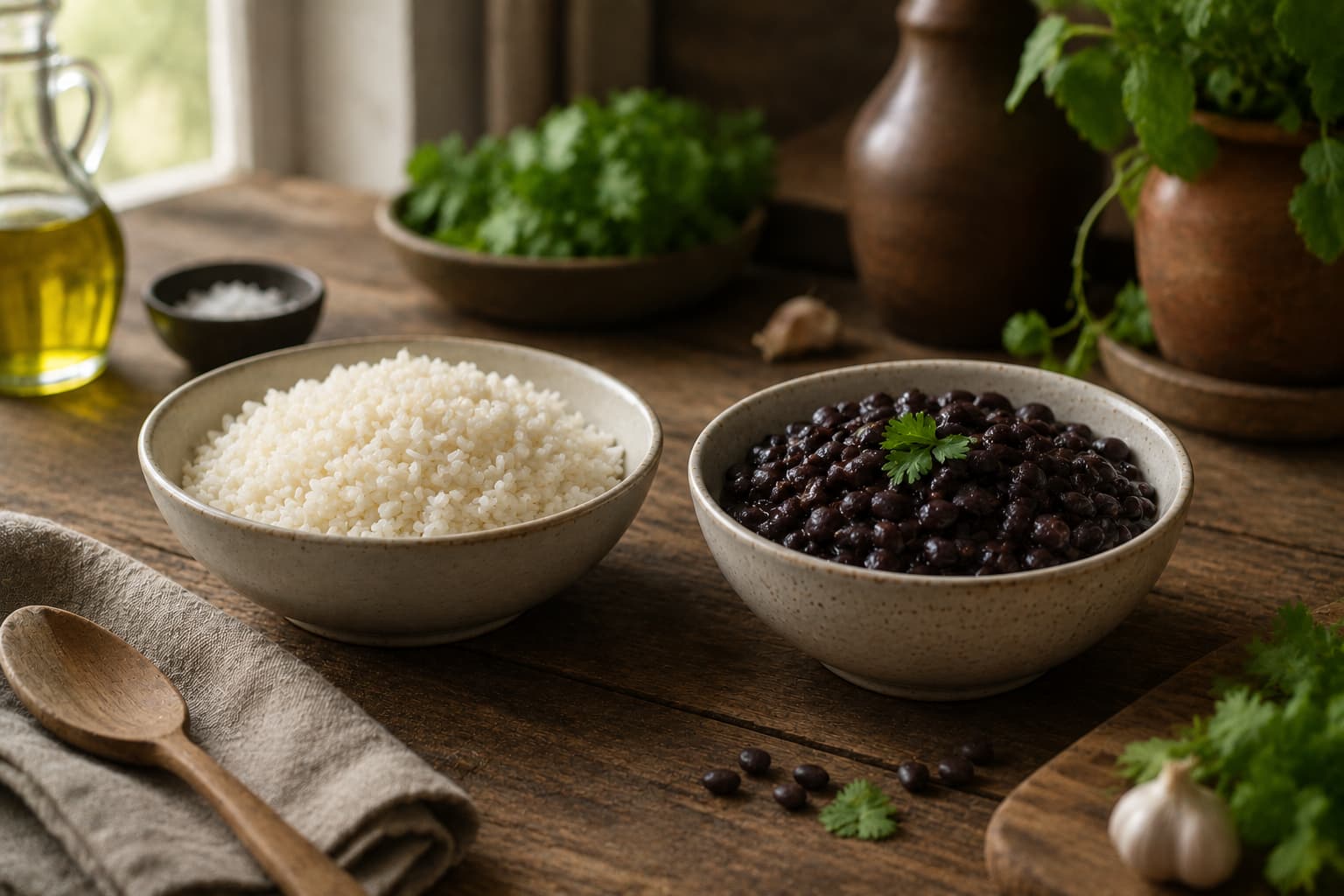
Across the world, from Latin America to the Caribbean to West Africa to South Asia, one humble pairing shows up again and again as the foundation of daily eating: rice and beans. It is one of the cheapest meals a person can make, it stores well, it fills the stomach, and it has quietly nourished billions of people through hard times and good. But there is something genuinely remarkable hiding inside this simple, thrifty combination. Together, rice and beans deliver something that neither can provide alone: a complete, high-quality protein rivaling that of meat, at a tiny fraction of the cost. Understanding why this works, and clearing up a stubborn myth along the way, reveals just how well a person can eat on very little money.
To understand the magic, you have to know a little about protein itself. Protein is built from smaller building blocks called amino acids, and of the roughly twenty the body uses, nine are considered essential, meaning the body cannot manufacture them and must get them from food. A food is called a complete protein when it contains all nine of these essential amino acids in good amounts. Animal foods like meat, eggs, and dairy are complete, which is part of why they are prized. Most individual plant foods, by contrast, are a little short in one or another of the essential amino acids, and that small shortfall is where the story of rice and beans begins.
The key lies in a concept called the limiting amino acid, the one that a given food does not supply enough of. Grains like rice have a specific weakness: they run low in an essential amino acid called lysine, while otherwise being decent sources of another called methionine. Legumes, the family that includes beans, lentils, and peas, have precisely the opposite profile. They are rich in lysine but a bit short on methionine. Look at those two profiles side by side and the solution almost jumps off the page. What rice lacks, beans supply in abundance, and what beans lack, rice provides. Put them together and the gaps in each are filled by the other, producing a protein profile that contains all nine essential amino acids in good measure. This elegant matching is what nutritionists call complementary proteins, and rice and beans are its most famous and delicious example.
This is not a quirk limited to that one pairing. The same principle explains why so many traditional cuisines evolved their staple combinations: beans on corn tortillas, hummus made of chickpeas with wheat pita bread, lentils with rice, peanut sauce over grains. Cultures that could not afford much meat discovered, through centuries of trial and taste, how to build complete nutrition out of cheap plants, pairing a grain with a legume. It is one of the quiet triumphs of human food wisdom, arrived at long before anyone had heard of an amino acid.
Now for the crucial correction, because there is a widespread myth attached to all of this that is worth putting to rest. For decades, people were taught that you must eat these complementary foods together in the very same meal, carefully combining your rice and beans on the same plate, or the trick would not work. This idea became enormously popular through an influential book from the early seventies, whose well-meaning author, not a nutritionist herself, suggested that plant eaters needed to practice careful protein combining at every meal to avoid deficiency. The advice spread everywhere, into classrooms and textbooks, and it still lingers today. But it turns out to be mistaken, and the author herself corrected it in later editions of her own book.
Here is the reassuring truth that nutrition science has established: you do not need to eat your grains and legumes in the same meal, or even within a few hours of each other. The body maintains a reserve, a kind of circulating pool of free amino acids, that it draws from throughout the day. If you eat rice at lunch and beans at dinner, your body simply combines the amino acids from both to build the complete protein it needs. What matters is not the precise timing of any single meal but the overall pattern of your diet over the course of the day. As long as you are eating a reasonable variety of plant foods and enough total calories, your protein needs take care of themselves. The pressure to engineer every plate perfectly was never real.
This makes eating well on a budget far simpler and less stressful than the old myth implied. The practical takeaway is not a rigid formula but a relaxed habit: build your meals around a rotating base of grains and legumes, and eat a variety of them across your days. A pot of beans simmered cheaply from the dried bag, a bag of rice, some seasonal vegetables, and a few spices can form the backbone of countless nourishing, complete meals. These staples are among the most economical foods on earth, they keep for a long time in the pantry, they are endlessly versatile across cuisines, and they deliver not just protein but fiber, iron, folate, potassium, and lasting energy.
There is a deeper lesson tucked inside this bowl of rice and beans. Affordable food is so often assumed to mean nutritionally poor food, a grim compromise between your wallet and your health. The humble grain-and-legume pairing proves that assumption wrong in the most satisfying way. Here is a meal that costs pennies per serving, that has sustained entire civilizations, and that provides protein every bit as complete as an expensive cut of meat. Eating well has never truly required a large budget, only a little knowledge and the willingness to lean on the simple, time-tested foods that people everywhere have relied on for generations. The next time you eat a plate of rice and beans, you can savor the fact that you are enjoying one of the smartest, cheapest, and most complete meals humanity has ever devised.
Across the world, from Latin America to the Caribbean to West Africa to South Asia, one humble pairing shows up again and again as the foundation of daily eating: rice and beans. It is one of the cheapest meals a person can make, it stores well, it fills the stomach,…